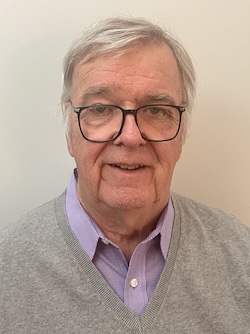
From his start as a student navigating Simon’s rigorous curriculum to a distinguished career in development and alumni relations, Charlie Miersch ’70S (MBA) has played a vital role in the school’s growth and identity. In this Q&A, he reflects on his journey, the evolution of Simon, and his enduring commitment to supporting future generations of students.
How did your path lead you to the Simon School?
I graduated from Lafayette College in 1968 as an ROTC Second Lieutenant. Surprisingly, the Army gave me two years off during the Vietnam War to continue my education. I had originally planned to go to law school, but business drew me in. The University of Rochester’s College of Business Administration—now Simon—offered full tuition and a stipend, and its talented faculty and rigorous academics made it an ideal fit.
What was your experience like at Simon?
It was challenging but incredibly rewarding. I came in as a political science major among classmates with strong backgrounds in economics, math, and engineering, so I felt a bit out of place at first. Still, I thrived on the intellectual rigor, the brilliant peers, and the analytical training. Those two years shaped how I approach problem-solving to this day.
How did you end up back at Simon?
While I was in California, Roger Lathan, then Director of Development at the University, contacted me about a role in the central development office. He explained it involved fundraising and improving the University’s reputation. The work appealed to me more than selling belts, so I returned to Rochester. Over time, my responsibilities grew, eventually encompassing the university’s annual fund. After 10 years in central administration, I joined, what would be Simon, as associate dean with responsibility for the school’s external marketing functions.
What changes did you see while you were there?
I was fortunate to be part of a team during a period of real growth for the school. Together, we helped raise $30 million in endowment funds, and the school was named in honor of Bill Simon, who was former Secretary of the Treasury, recognizing his vision and support. Over those years, Simon also saw increases in applications and GMAT scores, more students arriving with work experience, stronger alumni engagement, and improvements to facilities, including the Gleason and Schlegel buildings. It was rewarding to watch the school develop a true identity and home on campus, and I’m proud to have played a small role in supporting that progress.
What motivates you to give back to Simon?Supporting the school has always felt natural. It’s a way to give back and help the next generation of students and scholars succeed, just as so many people helped me along the way. The Simon School was a great place for me… Fortunately, I’m in a position now where I’m able to give back to the school. My bequest supports junior faculty research, and annual gifts help the school in other ways. I hope that students take what they learn here and, in turn, help future generations. It’s a way to keep the school strong and connected for years to come. What made the school special to you personally?Simon became central to my life. I met my wife here, built a long career, and developed deep connections with faculty and alumni. The intellectual environment was exhilarating—the analytical horsepower and freedom to explore ideas make it a unique place. | 
"The intellectual environment (of Simon) was exhilarating—the analytical horsepower and freedom to explore ideas make it a unique place."
—Charlie Miersch ’70S (MBA) |
What advice would you give to alumni?
Recommend the school widely, mentor students, and contribute however you can. The extent that you can help students—whether it’s counseling, mentoring, or providing introductions—you’d be surprised how valuable that is. And I would hope that 50 years from now, people will still say that Simon provides that kind of experience—and that we can do it while remaining relatively small and interconnected in ways that some bigger schools simply can’t. That would be my hope.