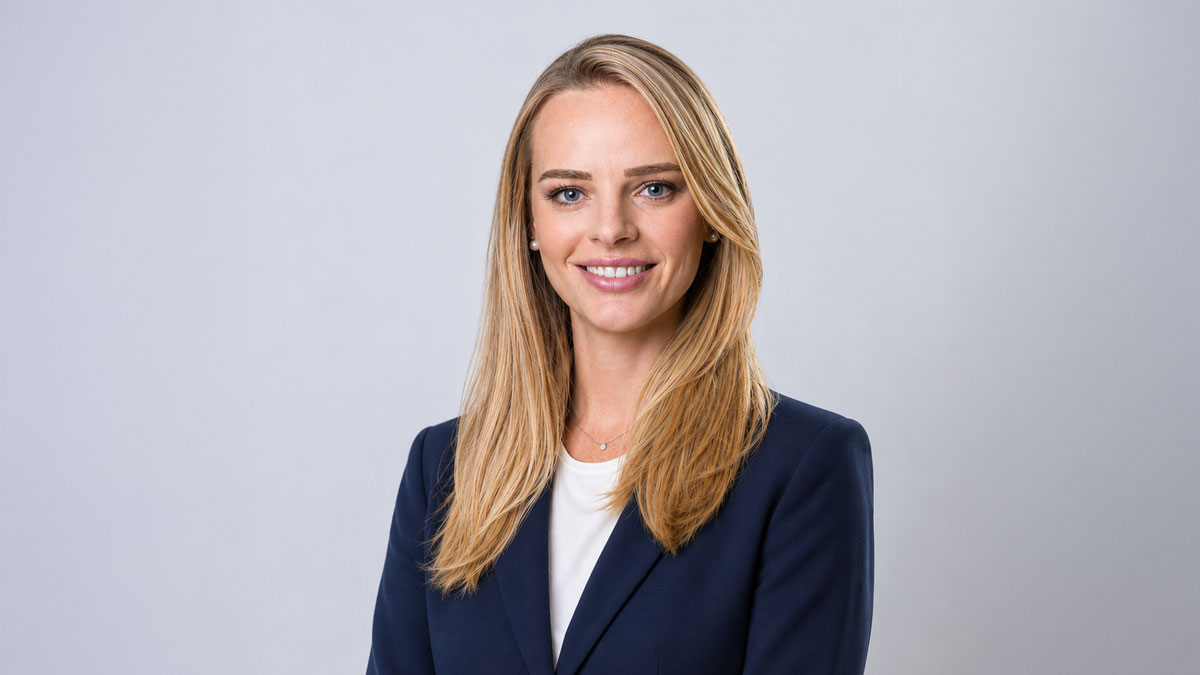
Location: São Paulo, Brazil
Simon Degree: MBA
Currently: Associate Risk and Resilience McKinsey & Company
Simon Impact: Wobeto credits Simon’s analytics coursework and experiential learning with shaping the approach she still relies on today: understand the problem, follow the data, then build the solution.
What initially drew you to Simon Business School, and how did you know it was the right fit for your career goals?
This will sound like a cliché, but it was mainly the people. I've heard this many times, and it was no different for me. I met many people from Simon, and they were humble and genuinely willing to help with any question I had. But beyond that, they reached out to me, offering to talk through whatever was on my mind about the decision. I was making this choice in the middle of COVID, so there was a lot on my mind, and the fact that people invested that kind of time in me, unprompted, was rare. I knew I wouldn't regret choosing Simon.
After that, the ROI from Simon was excellent. Alumni had excellent job placements, the school offered incredible scholarships for international students, and the costs were reasonable.
Was there a particular course, professor, project, or extracurricular experience at Simon that still influences how you approach problems today?
Yes! Ravi Mantena's Intro to Business Analytics — I can't say enough about how much I enjoyed his classes. Analytics wasn't a field I'd been exposed to much before Simon. My training in computer engineering, and the roles that followed, shaped a builder's instinct in me — solving problems by constructing systems, rather than an analyst's instinct for mining large datasets to surface insight. But analytics is a technical field at its core, and it overlapped naturally with who I already was — logical, technical, drawn to structure. I loved discovering how data itself could point toward the best decision, so I could go build the best solution.
Another Simon experience that shaped me was Simon Vision Consulting. I loved sitting with clients, listening to their problems, and working through to a solution that actually fits their business. Between Ravi's class and SVC, I picked up a habit I still rely on today: start with the client's actual problem, let the data tell me what's really going on, and only then design the solution — never the other way around. That sequence is still exactly how I approach every problem I get handed.
You began your academic journey in engineering and later built a career in risk, financial services, fintech, and consulting. How did that transition happen, and what skills proved most transferable?
Truth be told, I never set out to build a career in risk — it wasn't on my radar until I landed my first job in it. But looking back, the transition makes sense. Engineering trains you to break down complex systems, spot where they can fail, and design around that failure — which, it turns out, is basically the instinct risk work runs on. Simon's strategy and analytics coursework gave me the language and tools to translate that instinct into a business context: how to size a problem with data, structure an ambiguous question, and communicate a recommendation clearly. So when I landed my first job in fraud risk strategy and Analytics, it felt like a natural fit — it blended a technical field with business strategy, and let me use both halves of how I think. From there, I kept pursuing opportunities to go deeper: from fraud risk into broader financial services, then fintech, then consulting — each step adding a new layer of complexity to the same core skill set of identifying where things can break and figuring out how to prevent it.
You have worked at organizations including Capital One, Goldman Sachs, GreenSky, and now McKinsey & Company. What have those experiences taught you about how different organizations think about risk and decision-making?
Every organization's approach to risk is shaped by its scale, its capital position, and what it actually knows about its customer. But in every one of these organizations, data sits at the center of decisions. For instance, at Capital One, the innovative spirit means constantly challenging the status quo, even when that requires rebuilding a process from the ground up across multiple lines of business — a bet the company can make because of its scale and capital position. GreenSky takes a different path: with a narrow, well-understood customer base in home improvement financing and a leaner balance sheet, the business moves with more precision instead — tighter underwriting, sharper pricing, and faster decisions, since the risk profile is already well understood. Neither is the "better" model — one is built for scale and rigor, the other for depth and speed.
Ultimately, no business exists without taking on risk — the market is inherently uncertain, and there's no strategy that removes that. What these experiences taught me is that good risk work doesn't try to eliminate uncertainty — it turns uncertainty into competitive advantage. That's what I bring to McKinsey's clients.
What is one lesson you learned after graduation that you wish you had known while you were a student at Simon?
The "job vibe" is a real thing. Work is so much better when everyone brings good energy — and you don't need to be like "family" with your coworkers to have that. It's the basic things: "Good morning," "See you tomorrow," "Have a good weekend," "Let's grab coffee," "Happy Friday." I'll even risk sending the occasional GIF. It's really not that hard, and it makes a huge difference. It might feel a little awkward at first, but just embrace the opportunity — a small, genuine smile goes a long way.
Ready to Explore Your Own Simon Trajectory?
Move beyond the classroom and into your next chapter with a community invested in your success.